On the Way — reading 1 Thessalonians
Reading tools
Four ways of reading built up across the seven sessions
This course keeps returning to four habits of reading, each one introduced where it does its most important work and then carried forward through the rest of the letter. Together they are less a set of facts to learn than a way of paying attention — to a letter's shape, to a word's first owner, to a ceremony's real direction, and to a hope still arriving.
Each tool below has a primary home: the session where it is taught in full, with its infographic and its working explanation. It goes on being used, more lightly, in the sessions that follow.
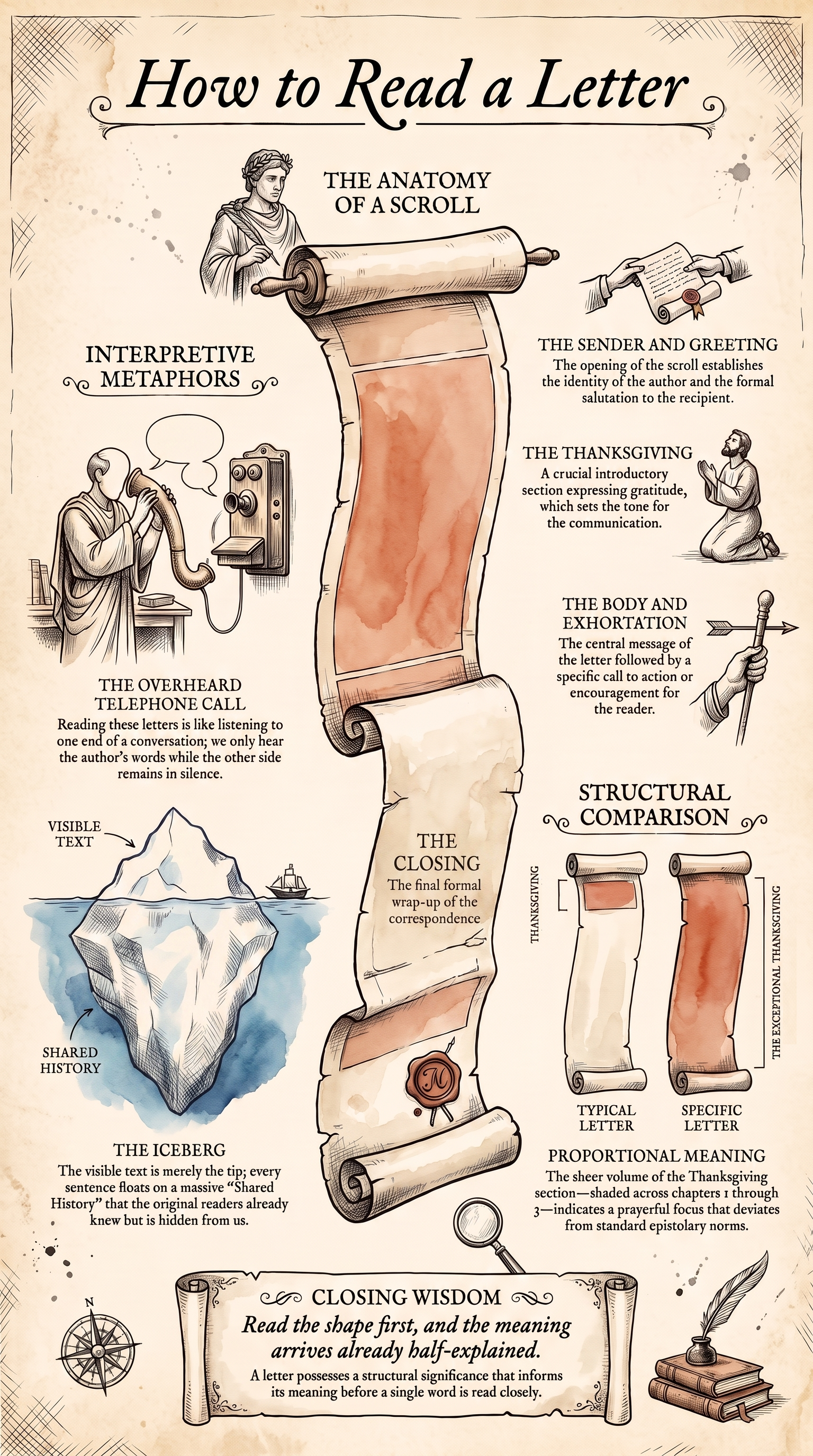
How to read a letter
A first-century letter had a shape as fixed as our own: sender and greeting, a short thanksgiving to the gods for the recipient's health, the body, the closing farewell. Thousands of ordinary examples survive on papyrus. Paul keeps the shape and converts every part of it — the greeting becomes grace to you and peace, the thanksgiving is addressed to the living God and filled with the congregation's own life, and the closing becomes blessing and holy kiss.
Morna Hooker gives two pictures for reading with the shape in mind. A letter of Paul's is one end of a telephone call, overheard: we hear him answer, and work out from the shape of his answers what the other end must have said. And a letter is the tip of an iceberg: beneath every sentence sits everything writer and hearers already shared, unexplained because it needed no explaining between them. The tool's first discovery in this letter is an overgrowth: the thanksgiving, a brief courtesy in every other letter of the age, runs from 1v2 to 3v13 — more than half the letter — and the form itself carries the message.
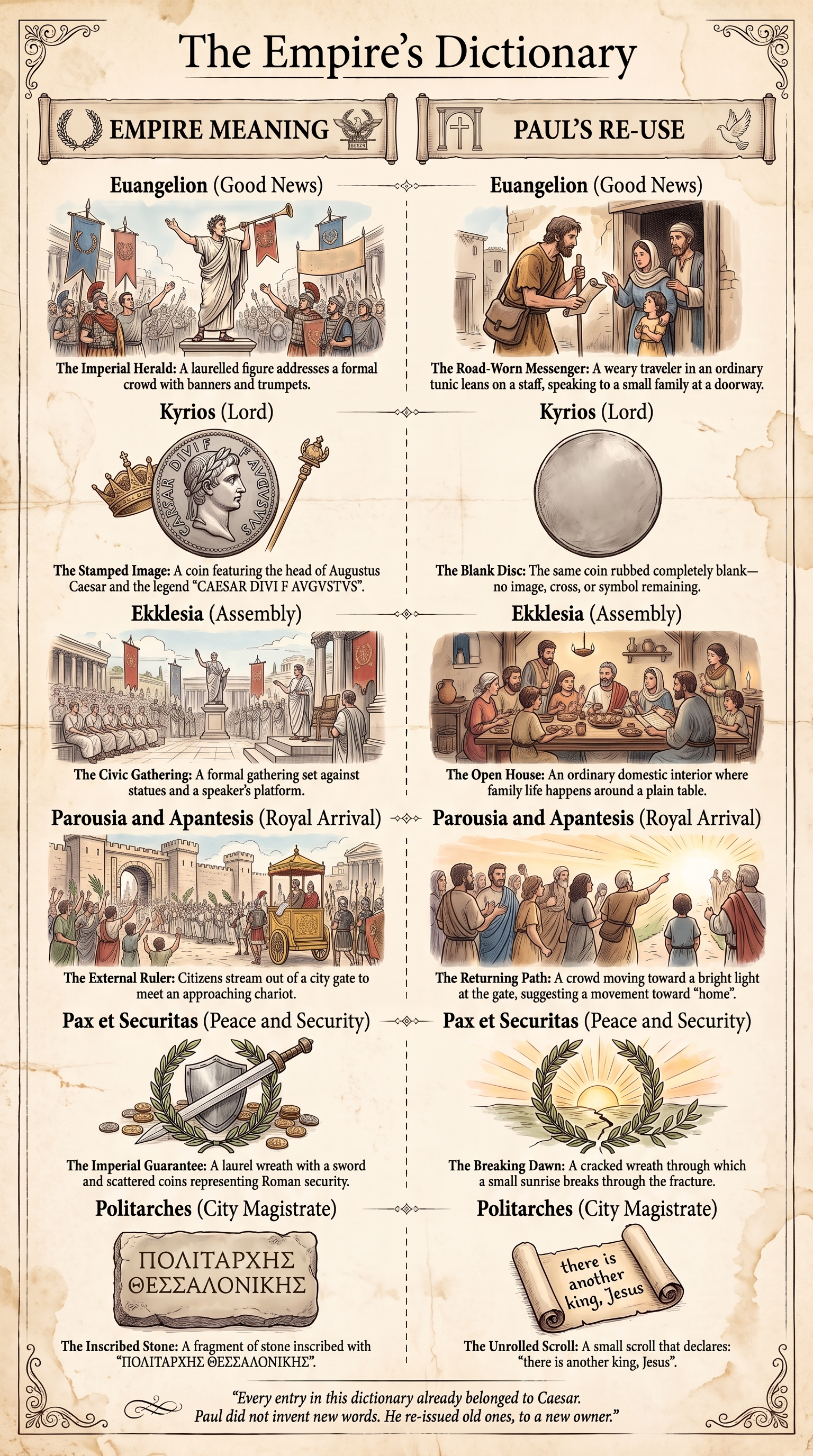
The empire's dictionary
The letter's central vocabulary all had prior owners, and first-century ears heard the prior owner every time. Euangelion, good news, was the empire's own word for news of an imperial birth or victory, made singular here where the empire's was plural. Kyrios, lord, was Caesar's title, given instead to a man the empire had crucified. Ekklēsia, church, was the free city's own citizens' assembly, refounded in a house open to labourers and nobodies. Parousia and apantēsis named the ceremonial of an imperial visit. And peace and security was the slogan of the whole Roman arrangement, which Paul quotes only to overturn it.
Reading with this dictionary open means catching, in ordinary-sounding words, a rival announcement running underneath the empire's own vocabulary — not decoration, but a deliberate act of borrowing and rewriting the words a Roman city used every day.
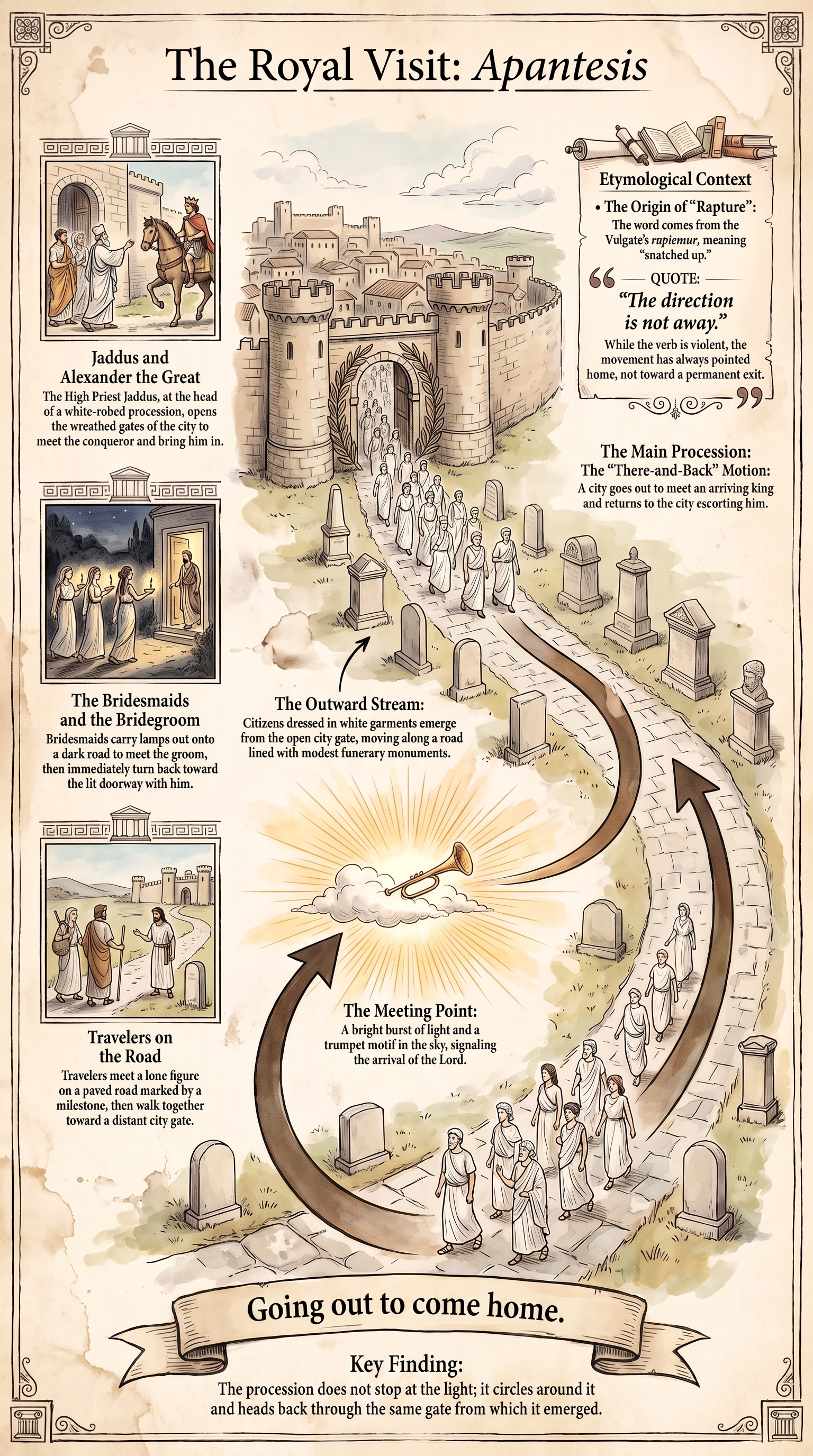
The royal visit
Parousia was the formal term for the arrival of a king or emperor at a city, prepared for months in advance. Apantēsis was the term for what the city did about it: the citizens streaming out through the gates, dressed in their best, to meet the arriving one on the road. And the meaning of the whole ceremony is in the return journey, because the delegation exists to escort the arriving one home — nobody in the picture is leaving.
Once this ceremony is seen, the letter's most misread passage reads itself. The dead, whose tombs lined the road outside every ancient city's walls, are the first anyone travelling that road would meet, so of course they rise first. The living go out to join the welcome. And forever with the Lord is the escorted homecoming, on a world being put right, not an evacuation to somewhere else.
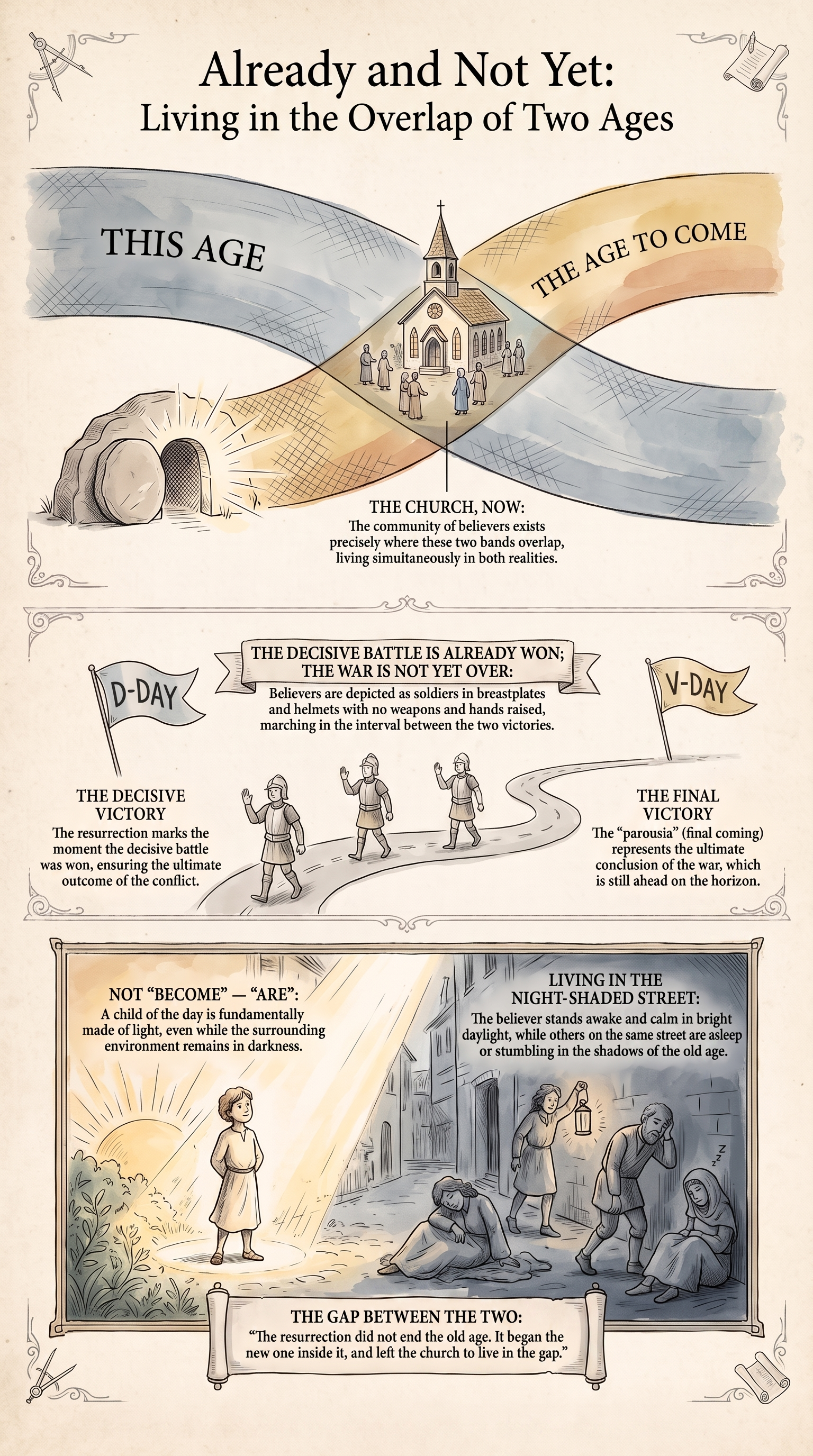
Already and not yet
Jewish hope spoke of two ages, one after the other: this present age, and the age to come, when God sets everything right. Paul's modification is that the ages now overlap. The new age has already begun — it began when God raised Jesus from the dead. The old age, with its powers and its slogans, has not yet ended. Believers live between the times: already children of the day, not yet standing in the day's fullness.
This grammar has been running under the letter since its first chapter, and this is where it gets its name. Transformation, on this reading, is a process rather than an instant; the tension between what has begun and what is still arriving is not a problem to be resolved but the actual shape of Christian time.
Reading 1 Thessalonians as architecture
None of these four tools is a trick for unlocking a single hard verse. Each is a habit of attention that changes what the whole letter looks like once it is switched on: the shape a letter must have and the shape this one refuses to keep to; the words a Roman port city used every day, quietly rewritten; the homecoming ceremony everyone in Thessalonica had watched at least once; and the overlap of two ages that makes sense of why a people already made of the morning still keep watch for it. Carried together, the four tools are less a toolkit than a lens — and the letter looks different, read through it, than it did before.