On the Way · Session 2
Faith, love, hope
1 Thessalonians 1v1–10
The oldest surviving Christian document opens with grace and peace already in place, and a thank-you that refuses to stop; the first time faith, love and hope stand together on a page, with hope last, because hope is what this letter exists to repair.
Pre-session video
1 Thessalonians 1v1–10, read in your own Bible during the week (NRSVA recommended). It is short, perhaps two minutes aloud; read it once quickly, in relief, the way a man paces the floor for news and finally gets good news. Then read it a second time, slowly, and mark anything that catches you and anything that troubles you. If the word wrath in verse 10 troubles you, good; bring it to the session.
Listen for three things as you read: a thank-you that will not behave like the short courtesy every ancient letter opened with; three words in verse 3, faith, love, hope, standing together for what is, so far as anyone can tell, the first time in Christian literature; and three verbs in verses 9 and 10, turned, serve, wait, somebody else's description of this congregation, quoted back to them, the whole converted life in one breath.
The thank-you that will not stop
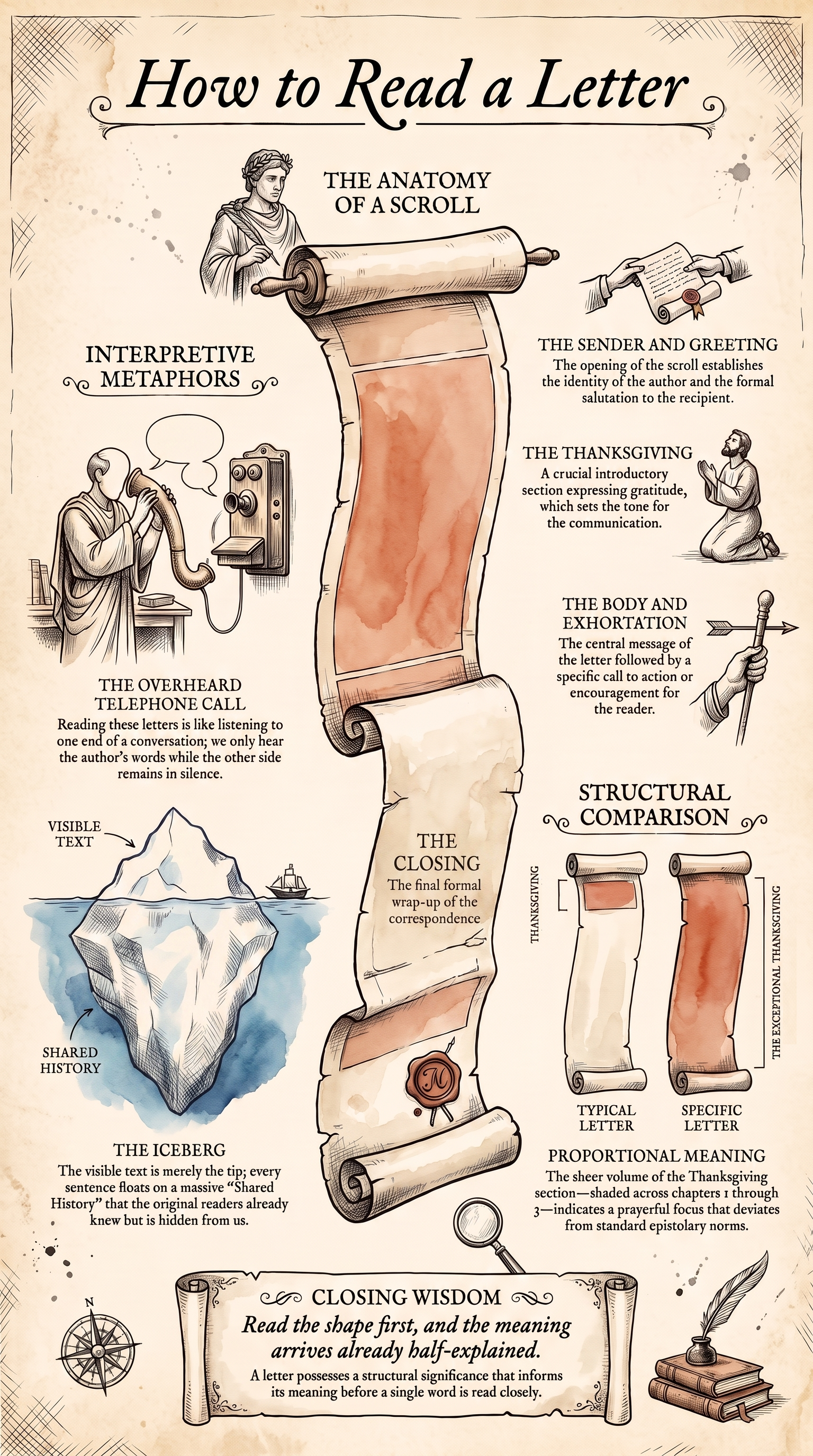
A first-century letter had a shape as fixed as our own: sender, greeting, a short thanksgiving to the gods for the recipient's health, the body, the farewell. Thousands of ordinary examples survive on papyrus; a soldier writes home that he thanks the lord Serapis for saving him at sea. Paul keeps the shape and converts it. The thanks go not to the gods but to the God and Father of our Lord Jesus Christ, and the courtesy becomes theology: what Paul is thankful for is what he believes God has done in these people.
Then the letter springs its surprise. In every other letter of Paul's the thanksgiving is a paragraph, warm and brief and done. Here it will not stop. He gives thanks again in chapter 2; in chapter 3 he asks what thanksgiving could ever be enough; the thank-you finally closes in a prayer at the end of chapter 3. More than half the letter is one long thanksgiving. Paul once wrote a letter so angry he cut the thank-you out altogether. This is the opposite letter. Put a young congregation under pressure into this man's prayers, and gratitude comes out that cannot find the brakes.
Faith, love, hope
Verse 3 names what he is thankful for: your work of faith and labour of love and steadfastness of hope. Look hard at those three words. We know them as a set; they have been carved and embroidered and sung for two thousand years. This is the first time — earlier than 1 Corinthians 13, earlier than any gospel — that anyone, so far as we know, wrote them down together, and it happens in a thank-you note to a workers' congregation in a Macedonian port.
Each word comes with an engine, not three candles on a shelf: the work faith does; the labour love takes on, and the word means toil, the kind that costs sweat; the steadfastness hope makes possible, the holding-on under load. And notice the order. When Paul writes to Corinth he will end the list with love, the greatest of these. Here he ends with hope. This congregation is grieving; some of their own have died, and Session 5 will be written straight into that grief. Hope stands last because hope is what this letter exists to repair.
Chosen: a new economy of honour
Verse 4: brothers and sisters, beloved by God; he has chosen you. In Thessalonica, belonging was a web of guilds and feasts and patrons and festivals, all of it threaded through the gods. To turn from the idols was to fall out of that web: invitations dried up, patrons looked elsewhere, family and workmates concluded you had gone strange, or worse, disloyal. Into that loss Paul speaks a new standing: chosen, beloved by God. It is not a doctrine about who is shut out. It is a word spoken to people the city had shut out, telling them who has taken them in.
Their answer has already made them famous: they received the word, under real pressure, with a joy the Spirit gave; they became imitators of Paul and of the Lord, and then an example to believers across two provinces; and the word of the Lord, Paul says, has sounded forth from them — a trumpet-blast of a word, the only place it appears in the whole New Testament. A congregation a few months old, audible across Macedonia and Achaia. Faith did not travel there by argument first; it travelled by imitation. Joy under pressure is a pattern you catch from a person, and once these believers had caught it, they became the pattern others caught it from.
Turned, serve, wait
Verses 9 and 10 are the earliest summary of the Christian life we possess: you turned to God from idols, to serve a living and true God, and to wait for his Son from heaven, whom he raised from the dead. Turned: conversion is not first a feeling or an opinion; it is an about-face, a reordering of loyalty, and in that city the cost of it could be counted. Serve: the time between the turning and the end is not a waiting-room; it is work. And wait: Paul reaches for a waiting-word he never uses anywhere else in his letters, the leaning-forward waiting of a harbour town watching for a sail, not the waiting of a bus queue.
One word may have troubled you: wrath. This is not a God with a temper, and it is not a threat hung over the room. In the prophets Paul grew up on, the wrath is God's settled refusal to make peace with injustice; the coming day when the world's wrongs are found out and put right. For a bruised little assembly on the wrong side of its own city, that is good news: the order that shut you out is not final. And notice the tense — Jesus is the one who rescues, present tense; the rescue is already under way.
Exegetical key video
Reading tool: how to read a letter
A Greco-Roman letter had a fixed anatomy: greeting, thanksgiving, body, closing; thousands of ordinary examples survive on papyrus, and the shape is as stable as our own conventions. Paul keeps the shape and converts every part of it. Morna Hooker gives two pictures for what reading these letters is like: a letter is one end of a telephone call, overheard, so we listen for the shape of what the other end must have said; and a letter is the tip of an iceberg, floating on a shared history we can only partly recover. The thanksgiving repays particular attention, because the themes named in thanks are reliably the themes the letter will treat — this letter's table of contents.
Practice for the week
Write a thanksgiving, Paul-style, for one particular person. Name, in your own words, their work of faith, their labour of love, their steadfastness of hope; be specific enough that the sentences could belong to no one else. Then give it to them — a card, a letter, a message, a word spoken face to face.
Materials for this session
Facilitator brief, participant workbook, and slide deck are available to registered leaders. Contact adrianroux@outlook.com for access. Pre-session participants are asked to read 1 Thessalonians 1v1–10 in their own Bibles during the week; the recommended translation is the New Revised Standard Version, Anglicised edition (NRSVA).