On the Way · Session 5
Caught up
1 Thessalonians 4v13–18
The letter's centre, and the course's flagship teaching: six verses written for a congregation that had buried some of its own, which turn out to be the New Testament's oldest consolation, and which a whole evacuation theology was built on by reading a royal welcome as a getaway.
Pre-session video
1 Thessalonians 4v13–18, read in your own Bible during the week (NRSVA recommended), slowly and aloud at least once; this is not a passage to read at pace. Between Paul's departure and this letter, people in the Thessalonian congregation died, and the survivors feared their dead would miss the Lord's coming. Notice exactly what verse 13 forbids — it is more careful than "do not grieve" — and notice the directions of travel in verses 16 and 17: who is coming, who is going out, and where everyone ends up. Some of you will read this with names in mind. That is not a distraction from the reading; it is the reading.
What verse 13 actually forbids
Hear what Paul does not say. He does not say, do not grieve. Read it as slowly as it deserves: do not grieve as others do who have no hope. The grief is not forbidden. The hopelessness is. Gravestones of Paul's world sometimes carried a standard pagan epitaph: I was not; I was; I am not; I care not — grief with nowhere to go. Against it Paul sets the thing his whole gospel rests on: since we believe that Jesus died and rose again, even so, through Jesus, God will bring with him those who have died. The dead in Christ have lost nothing. Death has not un-familied them.
The royal visit
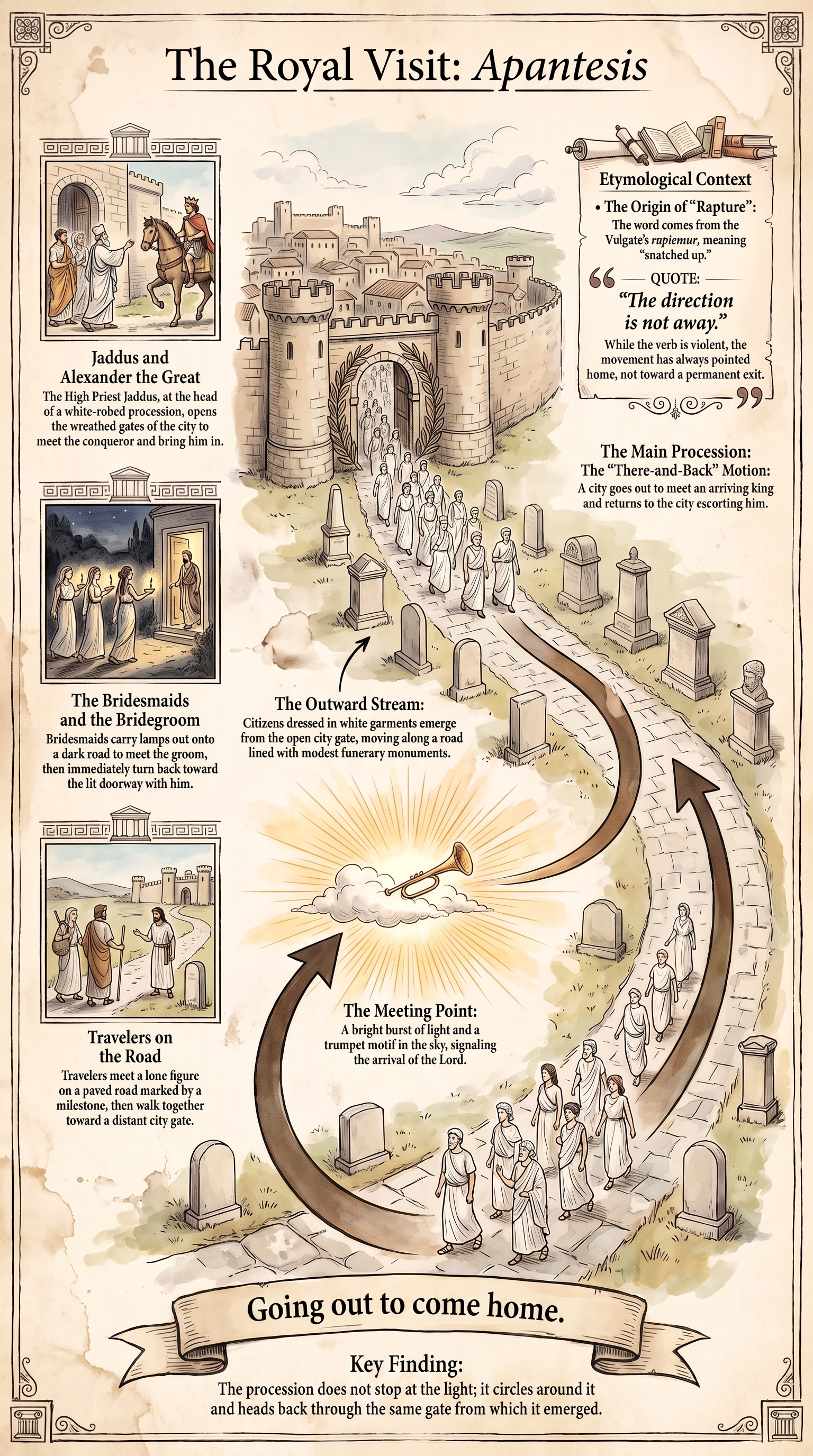
Two technical terms run through this passage, and first-century ears caught them instantly. Parousia was the formal word for the arrival of a king or emperor at a city, prepared for months in advance. Apantēsis was the word for what the city did about it: the citizens streaming out through the gates, dressed in their best, to meet the arriving one on the road. And here is the whole point of the ceremony: you did not walk out of your city to leave with the king. You walked out to welcome him, and then escorted him home. The meeting on the road exists for the sake of the return journey — the historian Josephus tells of the high priest Jaddus going out in white garments to meet Alexander the Great, and the visitation that could have been a catastrophe became a celebration.
Now watch the picture explain the strangest line in the passage. Why do the dead in Christ rise first? In an ancient city you buried your dead outside the walls, along the roads, so anyone arriving passed the tombs before reaching the gates. On the road into the city, the dead are the first ones you greet; they line the route, not the back of the queue. So look again at verse 17: the Lord descends, the dead are raised, and we are caught up together with them to meet the Lord in the air. Every arrow in that picture points down and home. The meeting in the air is the city streaming out through the gates, and what follows, in every parousia anyone in Thessalonica had seen, is the escort home. And so we will be with the Lord forever — here, on a world put right, with our dead restored to us.
Where the other reading came from
Honestly: not from the ancient church. For eighteen centuries no Christian tradition read this verse as a secret evacuation before a tribulation. That system was assembled in the eighteen-thirties, largely by John Nelson Darby of the Plymouth Brethren; it travelled into the mainstream inside the notes of the Scofield Reference Bible from 1909, was mass-marketed by Hal Lindsey's The Late Great Planet Earth in 1970, and sold in the tens of millions by the Left Behind novels from 1995.
Here is the sharpest single correction, and it turns on one small word. In Paul's own sentence, twice, we who are alive, who are left are the faithful. Being left is the blessed condition — alive on the earth when the Lord comes to it. The franchise took Paul's word for the blessed and made it a word for the damned. If you have ever lain awake fearing you would be left behind, hear this gently: in this passage, being left behind is the good news.
One more honest thing, because this course does not flinch: Paul expected to see the day himself, and on that question of time he was wrong, as every prediction of an imminent end has been wrong. But his proclamation was never mostly about dates. It was that the putting-right of the world has already begun, in the risen Jesus, and that we are invited into the process now. Which is why the passage ends not with further instructions but with a commission: therefore console one another with these words. Paul hands the comfort to the congregation. The words are now theirs to carry to one another.
Exegetical key video
Reading tool: the royal visit
Parousia, the formal arrival of a king; apantēsis, the citizens' reception, streaming out through the gates to meet the arriving one; and the meaning of the whole ceremony is in the return journey, because the delegation exists to escort the arriving one home. Once the picture is seen, 4v13–18 reads itself: the Lord descends; the dead, whose tombs lined the road outside every ancient city's walls, are greeted first; the living go out to join the welcome; and forever with the Lord is the escorted homecoming, on a world being put right, not an evacuation to somewhere else.
Practice for the week
Console one another with these words. This week, offer real consolation to someone bereaved: write a note, make a visit, or speak the name of someone's dead aloud with them rather than around them. Use the letter's own comfort if it helps — the dead in Christ lose nothing; grief is allowed; hopelessness is not. One person, one act, done gently.
Materials for this session
Facilitator brief, participant workbook, and slide deck are available to registered leaders. Contact adrianroux@outlook.com for access. Pre-session participants are asked to read 1 Thessalonians 4v13–18 in their own Bibles during the week; the recommended translation is the New Revised Standard Version, Anglicised edition (NRSVA).