On the Way · Session 1
The world turned upside down
Acts 17v1–9 with 1 Thessalonians 2v1–2
This letter is the oldest page in the New Testament. Twenty years after the crucifixion, a full generation before Mark, the first gospel — everything else in the New Testament comes after this. And its opening scene is a street riot in a free city that put god on its coins.
Pre-session video
Two short readings tell the story of how the gospel arrived in Thessalonica, from two witnesses. Acts 17v1–9 is Luke's account, written a generation later: the synagogue, the riot, a man called Jason dragged before the magistrates. 1 Thessalonians 2v1–2 is Paul's own memory of the same arrival: two verses, no riot; a beating at Philippi behind him, and courage in front of him. Read both, on different days if you can, in your own Bible (NRSVA recommended). Notice what only Luke tells you, and what only Paul tells you — the differences are part of the teaching.
One word to carry into the week: politarchēs, Luke's word for the magistrates Jason was dragged before. For centuries critics said Luke had made it up — the word appears almost nowhere in ancient literature. Then in 1876 workmen demolished an old Roman gate in Thessalonica, and out of the arch came a block of marble, now in the British Museum, carved with the names of the city's magistrates. Luke's word, cut in stone.
The oldest page
Start with a date. The crucifixion happened around the year 30. Mark, the first gospel, was written around 70; John, the last, around 95. This letter was written from Corinth around the year 50 — we can date it within a year or two, because Luke tells us Paul stood before the proconsul Gallio at Corinth, and a broken inscription at Delphi tells us exactly when Gallio held office: 51 to 52. Twenty years after the crucifixion; a full generation before the first gospel; by steady scholarly consensus, the oldest surviving Christian document there is.
And listen to what is already here, on this oldest page, before a single gospel existed. Grace to you and peace — already the greeting. Faith, love and hope — already standing together, with hope last, because hope is what the letter exists to repair. The death and resurrection of Jesus as the ground of everything. The Spirit as living presence. And a congregation of manual workers in a provincial port, learning how to grieve for their dead without despair. Christianity's oldest voice is not a creed and not a code; it is a pastor writing to the bereaved.
Two witnesses who don't agree
Luke, writing a generation after Paul, stages the arrival his standard way: Paul goes to the synagogue, some Jews believe, the rest grow jealous and raise a mob. Paul's own letter quietly contradicts it — his Thessalonian converts had turned to God from idols; they were pagans, not synagogue members, and the danger that drove him out was the kind that chases a man across a provincial border, which is how you flee Roman civil power, not synagogue discipline.
So here is the course's method, learned from this very passage: accept Luke where he agrees with Paul; set him aside where he disagrees; take him seriously where he reports something he had no reason to invent. Because Acts 17 is wrong and right in the same paragraph. The jealousy framing is Luke's theology. But the charge actually read out before the magistrates rings true, and Luke never answers it: acting contrary to the decrees of the emperor, saying that there is another king named Jesus.
A city that put god on its coins
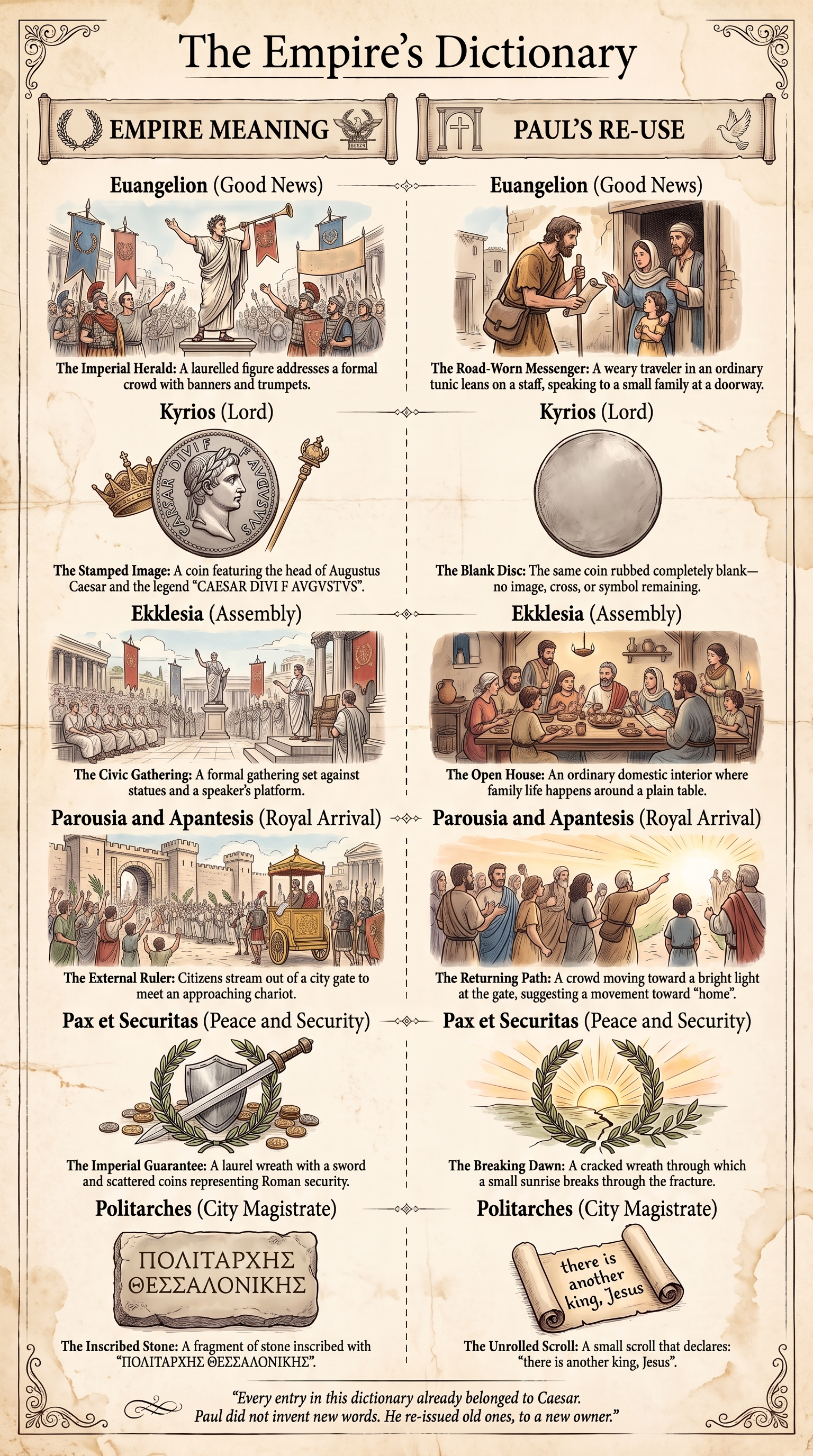
Thessalonica had bet well on Rome's civil wars — a free city since 42 BC, self-governing, living on imperial patronage. It kept its accounts in public: coins minted with the wreathed head of Julius Caesar and one word, ΘΕΟΣ, god. Up the Via Egnatia into that city, around the year 49, walks a Jewish leather-worker, fresh from a public beating at Philippi, carrying not a rival army but a rival dictionary — euangelion, good news, singular where the empire's was plural; kyrios, lord, of a man the empire crucified; an ekklēsia, a rival citizens' assembly, open to labourers and nobodies.
So when the mob dragged Jason before the magistrates instead of Paul, the charge they shouted was not a paranoid misreading: these people who have been turning the world upside down have come here also... they are all acting contrary to the decrees of the emperor, saying that there is another king named Jesus. The accusers heard the gospel correctly — more clearly, perhaps, than centuries of comfortable Christianity have managed to hear it.
Exegetical key video
Reading tool: the empire's dictionary
The letter's central vocabulary all had prior owners, and first-century ears heard the prior owner every time: euangelion, the empire's plural good news, made singular; kyrios, Caesar's title, given to a crucified man; ekklēsia, the free city's own assembly, refounded in a house open to everyone; parousia and apantēsis, the ceremonial of an imperial visit (Session 5 will make this the hinge of the letter's most misread passage); peace and security, the slogan of the whole arrangement, which Paul quotes only to overturn it.
Practice for the week
Read 1 Thessalonians whole, aloud, alone, in one sitting — about twenty minutes. The letter ends with an oath that it be read aloud to the whole assembly (5v27); hearing it whole is the nearest we can get to its first hearers' seats. If you can, read it once early in the week and once late, and notice what the second hearing gives you.
Materials for this session
Facilitator brief, participant workbook, and slide deck are available to registered leaders. Contact adrianroux@outlook.com for access. Pre-session participants are asked to read Acts 17v1–9 and 1 Thessalonians 2v1–2 in their own Bibles during the week; the recommended translation is the New Revised Standard Version, Anglicised edition (NRSVA).