On the Way · Session 6
Children of the day
1 Thessalonians 5v1–11
Last week Paul answered what about our dead. This week he answers the question everybody asks next — when? — with one of the most bracing refusals in the New Testament: no timetable, a mocked imperial slogan, and an identity rather than an instruction: you are already children of the day.
Pre-session video
1 Thessalonians 5v1–11, read in your own Bible during the week (NRSVA recommended), twice — once straight through at a walk, once slowly with a pencil, marking the verse where they and them become you and we, and marking the quotation marks in verse 3, which matter. Notice what troubles you; verse 3 has a hard edge, and the session will not pretend it does not.
The refusal
Concerning the times and the seasons, Paul says, you do not need to have anything written to you. He will not give them a calendar, and the image he reaches for is built to end all calendar-making for good: the day of the Lord will come like a thief in the night. A thief who gives notice is not a thief. There is no rota of signs to watch, nothing to compute; the whole point of a thief is that the first you know of him is his arrival. Every chart of the end times, every confident date on a poster — the image forbids the lot. From the beginning, the community that most expected the Lord's coming was forbidden to calculate it.
Peace and security
Now the most politically pointed sentence in the letter: when they say, "There is peace and security", then sudden destruction will come upon them. Look at the quotation marks — Paul is quoting somebody, and his first hearers did not need telling whom. Pax et securitas was what Rome said it had given the world: peace bought by defeating your enemies, and delivered, so the propaganda ran, to every province around the Mediterranean. Thessalonica had staked everything on that promise — a free city for backing the winner, a temple of Caesar, the word god on its small change. Into that city Paul writes: when they say "peace and security", sudden destruction. There will be peace on earth, said Roman imperial theology, when all is quiet and orderly. There will be peace on earth, said Pauline Christian theology, when all is fair and just.
But look at the image Paul chooses for the destruction: not a bomb under the empire, but labour pains coming upon a pregnant woman. Sudden, yes; unstoppable, yes. But a labour pain is not pointless violence; it is the pain that delivers new life. What ends the false peace, in Paul's picture, is not arbitrary catastrophe. It is birth.
Children of the day
At verse 4 the whole passage turns on two words: but you. Up to now it has been they and them — those who say "peace and security", those who are caught. Now Paul looks straight at his congregation: but you, beloved, are not in darkness, for that day to surprise you like a thief; for you are all children of light and children of the day. It is not an instruction to try hard enough that the day will not catch you. It is an identity: you are. Children of the day are made of morning, and the day cannot ambush people who are made of it — dawn has never yet taken the daylight by surprise. For all its thief and its sudden destruction, this passage is not an anxious text. Believers do not fear the day, and they do not calculate it, for the same reason: they already belong to it.
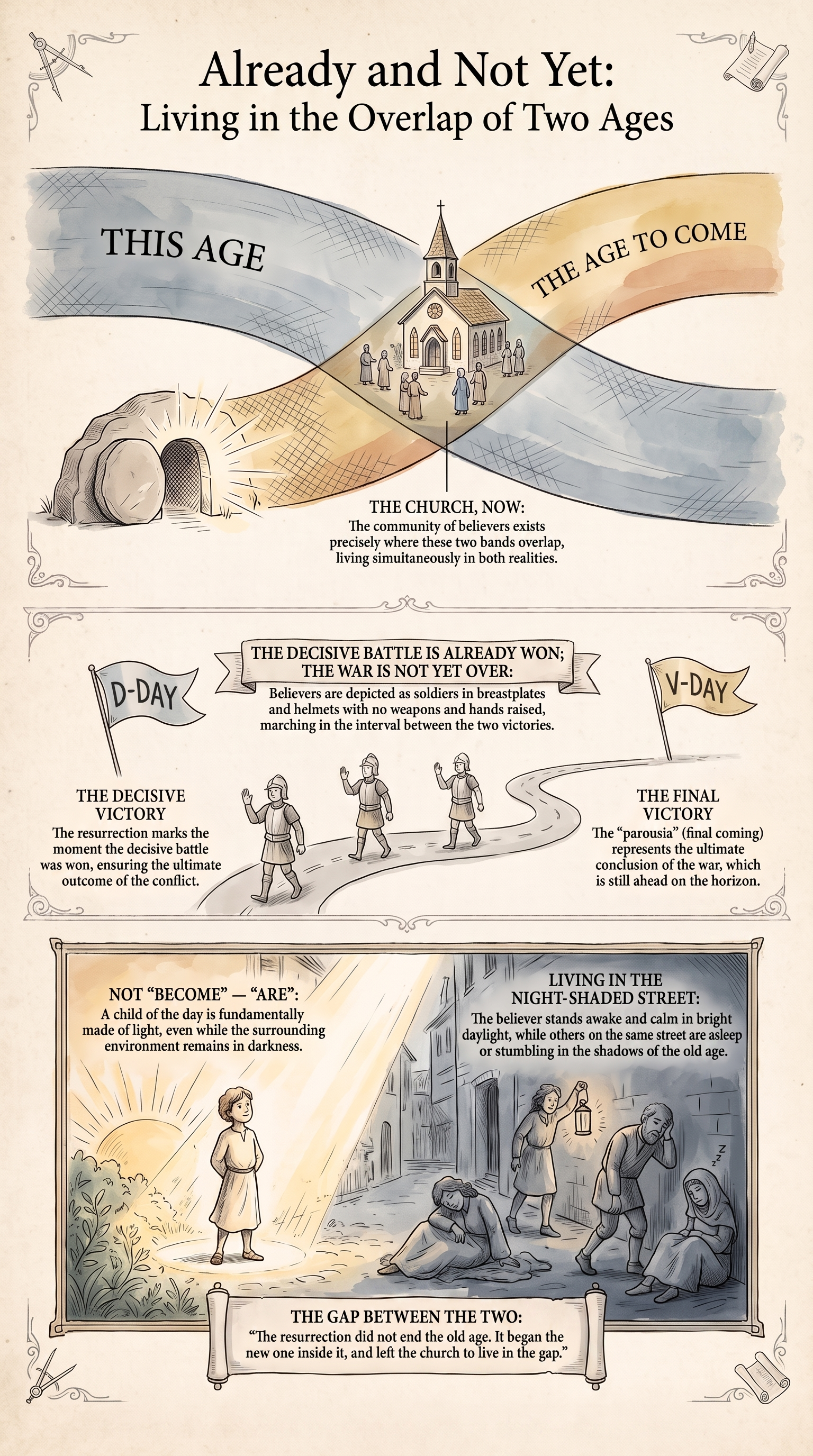
This is the grammar the whole course runs on. Jewish hope spoke of two ages, one after the other; Paul's modification is that the ages now overlap. The new age began when God raised Jesus from the dead; the old age, with its powers and its slogans, has not yet ended. Believers live between the times — already children of the day, not yet standing in the day's fullness. Transformation, on this grammar, is a process, not an instant.
Armour for the watch
What do people who belong to the day actually do in the meantime? They keep awake, and they keep sober; not joyless, but clear-eyed. Isaiah once pictured God, appalled that there was no justice, putting on righteousness like a breastplate and the helmet of salvation, and going out to set things right himself. Paul takes that armour off God's shoulders and hands it to a congregation of manual workers: put on the breastplate of faith and love, and for a helmet the hope of salvation. Faith, love and hope — the triad from the letter's opening thanksgiving, back again near its close, hope last both times, because hope is what this letter exists to repair. And notice the armour is entirely defensive, for the heart and the head. In the whole of this letter, the church's only weapons are faith, love and hope.
Then the destination, in full weight: God has destined us not for wrath but for obtaining salvation, so that whether we are awake or asleep we may live with him. The sleeping, in this letter, are the dead; the distinction that had been tearing this congregation apart with grief is named one last time, and dissolved. And so the last verse, word for word the note last session ended on: therefore encourage one another and build up each other. Not a timetable. Not fear. The church does not need a watchman posted on the wall calling that all is quiet; it is the watch — awake together before first light, telling one another that the morning is coming because they can already feel it.
Exegetical key video
Reading tool: already and not yet
Jewish hope spoke of two sequential ages: this present age, and the age to come, when God sets everything right. Paul's modification is that the ages now overlap — the new age began when God raised Jesus from the dead; the old age, with its powers and its slogans, persists; and believers live between the times, already children of the day, not yet standing in the day's fullness. This tool has been running under Sessions 1, 2 and 5 already; here it gets its name.
Practice for the week
Begin each morning by naming yourself a child of the day. Say the breastplate prayer aloud as you dress: I put on the breastplate of faith and love; I put on, for a helmet, the hope of salvation. Three words, worn deliberately: faith, love, hope. Then walk into the day you already belong to.
Materials for this session
Facilitator brief, participant workbook, and slide deck are available to registered leaders. Contact adrianroux@outlook.com for access. Pre-session participants are asked to read 1 Thessalonians 5v1–11 in their own Bibles during the week; the recommended translation is the New Revised Standard Version, Anglicised edition (NRSVA).